

German WWI Badge – Woyrsch
$65.00
1 in stock
Description
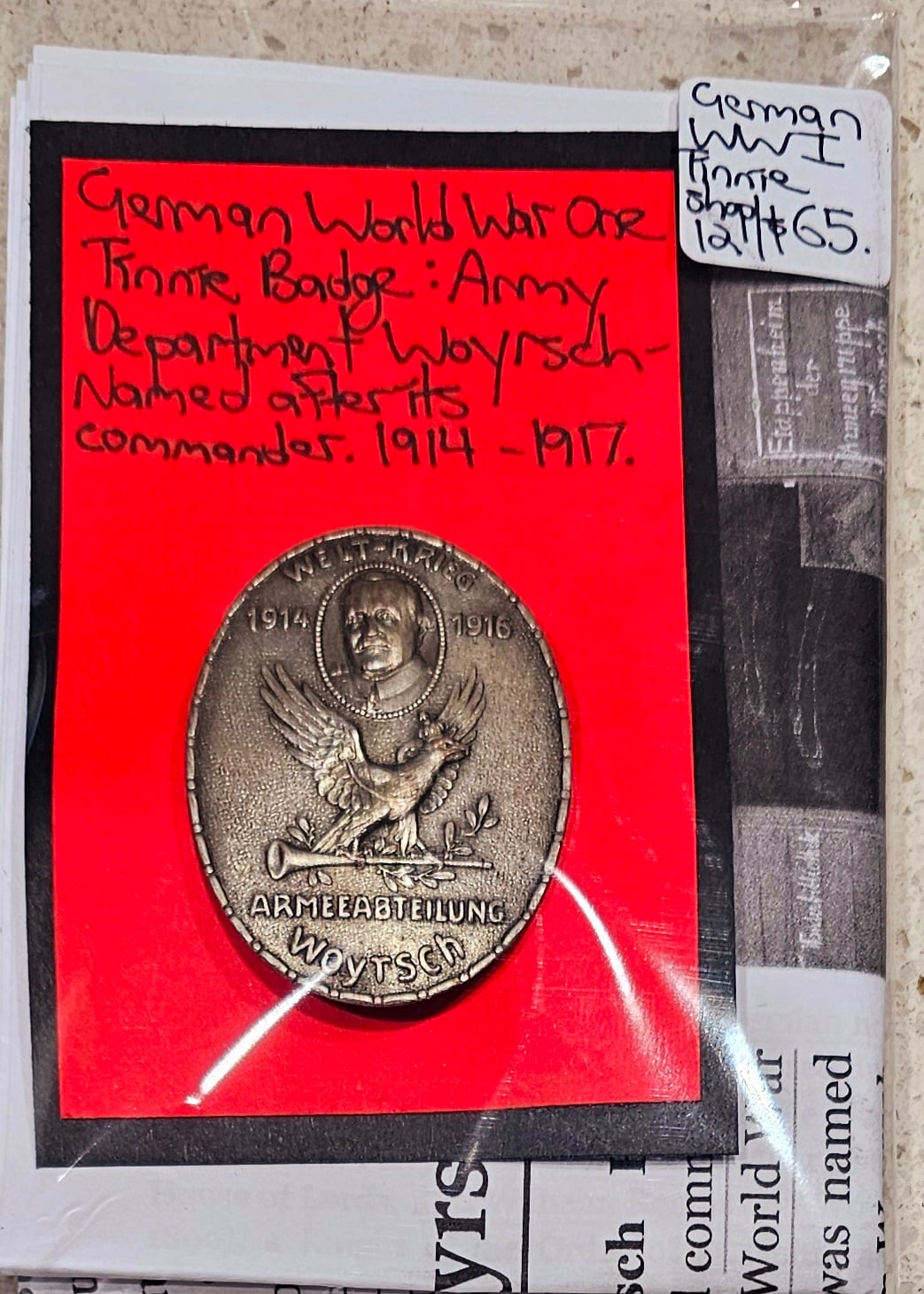
Badge measures 3cm x 4cm. The Army Department Woyrsch was named after its Commander. The unit existed from 1914 to 1917, when it was disbanded. The following information has been taken from Wikipedia about the unit & commander:
Armee-Abteilung Woyrsch was formed on 3 November 1914 under the command of Generaloberst Remus von Woyrsch. It was dissolved on 15 December 1917.
Armee-Abteilung Woyrsch was commanded throughout its existence by Generaloberst (later Generalfeldmarschall) Remus von Woyrsch. Woyrsch was the commander of the Landwehr Corps, an appointment he retained concurrently until 20 September 1916. A deputy, Generalleutnant Götz Freiherr von König, took command of Landwehr Corps on 3 December 1914. On 29 August 1916, Woyrsch also took over command of Heeresgruppe Leopold from Generalfeldmarschall Prince Leopold of Bavaria and the command was renamed Heeresgruppe Woyrsch.
Martin Wilhelm Remus von Woyrsch (4 February 1847 – 6 August 1920) was a Prussian field marshal, a member of the Prussian House of Lords from 1908 to 1918, and an Ehrenkommendator or Honorary Commander of the Order of St. John.
Remus von Woyrsch was born at the estate Pilsnitz (Pilczyce) near Breslau (Wrocław) in Prussian Silesia. He came from old Bohemian nobility, first from South Bohemia and then from ca. 1500 in Troppau (Opava) in Moravian Silesia. He married Thekla von Massow (1854–1943) from East Prussia, on 26 September 1873 in Potsdam, Brandenburg. She was the daughter of the royal Prussian forester Hermann von Massow.
His nephew Udo von Woyrsch (1895–1983) was an SS Obergruppenführer and SS and Police Leader.
After Woyrsch finished high school in Breslau, he joined the 1st Potsdamer Garde-Grenadier Regiment on 5 April 1866. He served at the battle of Königgrätz in 1866. He later fought in the 1870–71 Franco-Prussian war where he was wounded but earned the Iron Cross. In 1901 Woyrsch was promoted to divisional commander.
He retired in 1911 but was re-activated in August 1914 to command the Landwehr Corps and was quickly sent to help the Austro-Hungarian Army fighting in partitioned Poland. He came up to the Vistula, and then reinforced the left wing of the Austro-Hungarian army under General Viktor Dankl von Krasnik. In the three days of battle against the Imperial Russian army Woyrsch covered the retreat of the Austrians with his Landwehr corps. A St. Petersburg newspaper wrote that: “Only the activity of the small Prussian Landwehr troops in this battle prevented the complete destruction of the Austrian army.” Later he was included in Paul von Hindenburg‘s 9th Army. In July 1915 Woyrsch was involved in the breakthrough battle of Sienno near Wongrowitz (Wągrowiec). In 1916 he helped fight off the Russian Brusilov Offensive and in 1917 was promoted Generalfeldmarschall.
In 1920 Woyrsch retired, again, to his family estate at the castle Pilsnitz near Breslau. After his death the Silesian sculptor Paul Ondrusch created a wooden sculpture of Woyrsch to decorate the main hall inside the town hall of Leobschütz (Głubczyce). Woyrsch was portrayed as a knight wearing a coat and a chain mail, with his hands placed on a handle of a large sword resting against the ground.